🔴 LIVE UPDATE — MSF: "Most Cases Ever Seen This Early in Any Ebola Outbreak"
Medical humanitarian organisation Doctors Without Borders (MSF/Médecins Sans Frontières) has issued its most alarming statement yet on the 2026 Ebola outbreak. MSF Deputy Director Dr. Alain Gonzalez declared on Saturday that the situation in Ituri Province, DRC is "extremely alarming" — warning that in no previous Ebola outbreak have so many cases emerged in such a short period after the official declaration. WHO Director-General Dr. Tedros Adhanom Ghebreyesus personally travelled to Ituri Province to assess containment efforts. The DRC has now surpassed 1,000 suspected cases with at least 246 deaths. Uganda reports 9 confirmed cases and 1 confirmed death.
- 🔴 DRC total: 1,000+ suspected cases — at least 246 deaths (latest figures)
- 🔴 Uganda: 9 confirmed cases, 1 confirmed death
- ⚠️ MSF Deputy Director: "No previous Ebola outbreak has seen this many cases so soon after declaration"
- ⚠️ MSF: Ground teams "have not yet been able to effectively counter the rapid spread of the outbreak"
- ⚠️ Dr. Gonzalez: "No one fully knows the true scale — new suspected cases daily, hundreds of samples still untested"
- 🌍 WHO chief Dr. Tedros visited Ituri Province — the most severely affected area
- 🚧 Containment severely hampered by: border closures, airport closures, and active armed conflict in DRC
- 🚧 MSF: Humanitarian aid delivery facing "major obstacles" due to border and airport closures
- 📍 Armed conflict in eastern DRC continues to block response operations and accelerate viral spread
Source: BBC / Doctors Without Borders (MSF) — statement by Deputy Director Dr. Alain Gonzalez. Last updated: 31 May 2026. This is an active, rapidly evolving outbreak — situation may have changed since publication.
📅 May 25 CDC Update: American Patient, Flight Rerouting & Outbreak Spreads to Sud-Kivu
The CDC has published a major update as of 25 May 2026. An American national who was exposed to Ebola while caring for patients in the DRC has tested positive for Ebola Bundibugyo disease and has been transported to Germany for treatment — Germany was selected due to shorter flight time and its prior experience managing Ebola patients. The outbreak has now spread to a third DRC province: Sud-Kivu, in addition to the previously affected Ituri and Nord-Kivu provinces. The United States has activated enhanced border security measures, rerouting all flights from DRC, South Sudan, and Uganda to arrive only at Washington-Dulles (IAD) and Atlanta Hartsfield-Jackson International Airport for enhanced screening.
- 🇺🇸 No Ebola cases in the United States — CDC confirms risk to the US general public remains LOW
- 🏥 American healthcare worker exposed in DRC tested positive — transported to Germany for treatment and care
- 🇩🇪 High-risk contacts associated with the American case moved to Germany and the Czech Republic
- ✈️ US travel measure (from May 18): flights from DRC, South Sudan & Uganda rerouted to Dulles (IAD) and Atlanta (ATL) for enhanced screening
- 📍 NEW: Ebola now confirmed in Sud-Kivu Province — previously only Ituri and Nord-Kivu provinces affected
- 🇨🇩 DRC totals (as of May 25): 906 suspected cases · 105 confirmed cases · 223 suspected deaths · 10 confirmed deaths
- 🇺🇬 Uganda totals (as of May 25): 7 confirmed cases · 1 confirmed death · 5 cases with clear links to first 2 confirmed cases
- ⚠️ Case counts are rapidly evolving — subject to change. CDC, WHO, and ECDC are the authoritative sources
Last updated: 25 May 2026 — Source: CDC (US Centers for Disease Control and Prevention). This is an active outbreak. Check CDC.gov, WHO.int, and ECDC.europa.eu for the most current guidance and case counts.
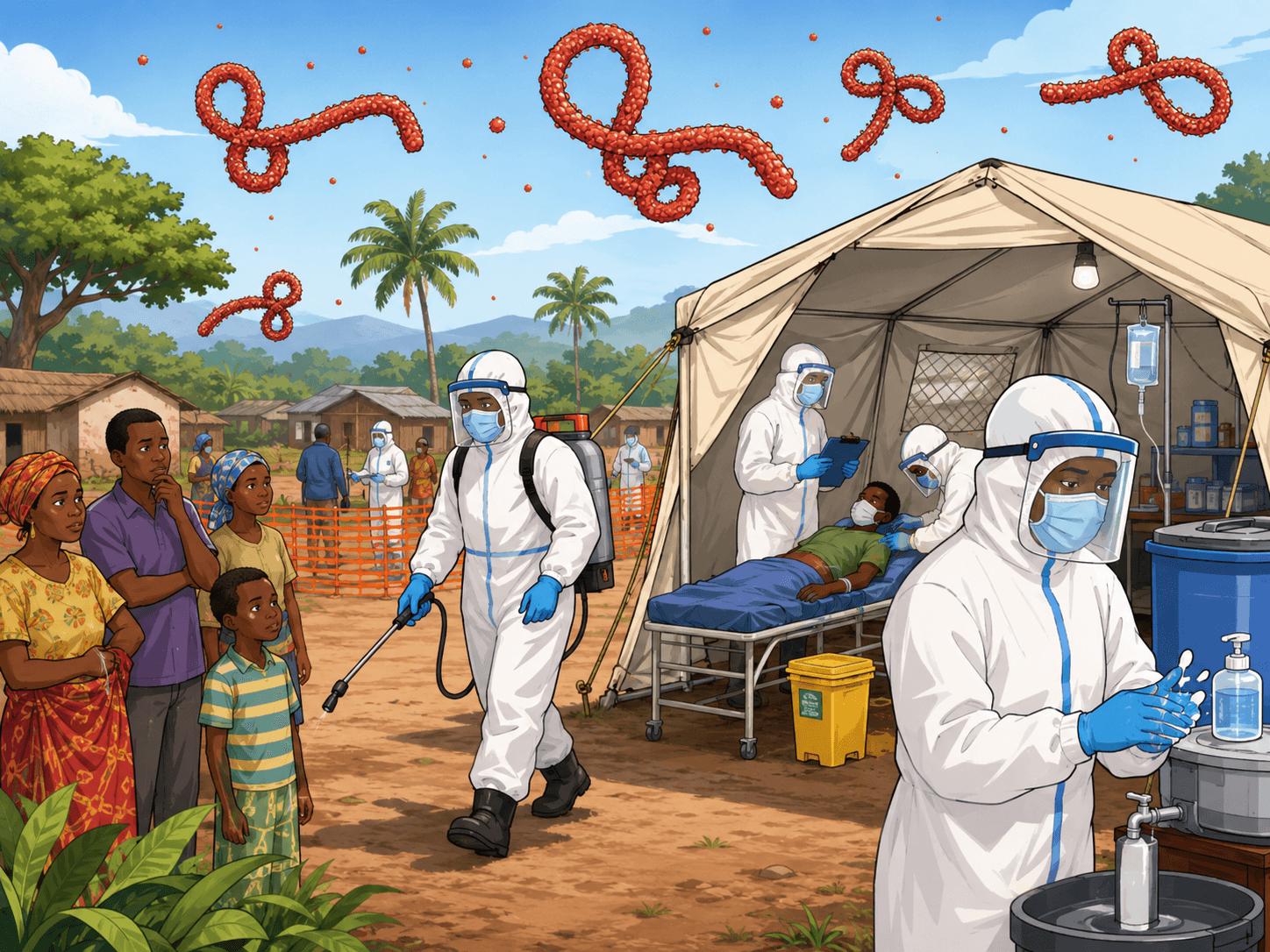
WHO Warning: Ebola Spreading Faster Than Initial Estimates
Prior to the May 25 CDC update, the World Health Organization had already issued a stark warning that the 2026 Ebola outbreak in the DRC was spreading significantly faster than initial estimates. With 906 suspected cases now recorded and spread confirmed across three provinces, the trajectory is consistent with the WHO's concern. The true case count is believed to be substantially higher than official figures, as the remote and conflict-affected geography of Ituri Province limits detection capacity. Rwanda has closed its border with DRC; Uganda has advised citizens to avoid handshakes and physical greetings.
- WHO PHEIC declared: 17 May 2026 — first time a PHEIC was declared without an expert committee recommendation, reflecting extreme urgency
- Strain: Bundibugyo virus — NO approved vaccine or specific treatment exists for this strain
- Rwanda: has CLOSED its border with DRC as a precautionary measure
- Uganda: advised public to avoid handshakes and physical greetings
- Red Cross: warned that conditions for rapid spread are present — early detection and public information are critical
- London research institute (Imperial College): estimated actual cases may exceed 1,000 due to underreporting
What Is a PHEIC — and Why It Is Not a Pandemic
A Public Health Emergency of International Concern (PHEIC) is the WHO's highest formal alert for an event that is "serious, unusual or unexpected" and carries a risk of international spread requiring a coordinated international response. It is not the same as a pandemic. The COVID-19 pandemic was declared a "pandemic emergency" — a separate and higher classification introduced after COVID-19 — specifically because it had already spread to every region of the world with widespread community transmission. The 2026 Ebola outbreak, while declared a PHEIC, is currently concentrated in two countries (DRC and Uganda) with no documented sustained transmission outside Africa. WHO Director-General Tedros stressed that this does not meet pandemic criteria and explicitly advised against border closures or travel bans.
- PHEIC = "Public Health Emergency of International Concern" — WHO's international alert mechanism
- Past PHEICs include: Swine flu (2009), Polio (2014), Zika (2016), COVID-19 (2020), Mpox (2022, 2024)
- A PHEIC triggers international funding, resource coordination, and emergency response protocols
- Pandemic emergency = a higher classification, requires global spread with community transmission
- 2026 Ebola: PHEIC yes — Pandemic no
- WHO advises against: border closures, travel bans, trade restrictions
WHO Director-General Tedros made history with this declaration — it is the first time a PHEIC has been declared without first seeking the recommendation of an expert emergency committee, citing the urgency and speed of the outbreak's international spread.
The Bundibugyo Strain: Why This Ebola Is Different and More Dangerous to Contain
Not all Ebola outbreaks are the same. There are six known species of Orthoebolaviruses, and each behaves differently. The Zaire strain — responsible for the 2014–2016 West Africa epidemic that killed over 11,000 people — now has an approved vaccine (Ervebo) and approved treatments (Inmazeb, Ebanga). The 2026 outbreak is caused by the Bundibugyo virus, a significantly rarer strain first identified in Uganda in 2007. The critical difference in 2026: there is no approved vaccine and no approved treatment for Bundibugyo. The DRC Health Minister described the lethality rate as "very high" — up to 50% — meaning roughly one in two confirmed cases is dying.
- Bundibugyo virus: first identified in 2007 in Bundibugyo District, Uganda
- Lethality rate: up to 50% — historically 25–50% in previous Bundibugyo outbreaks
- No Bundibugyo-specific vaccine exists — the Ervebo (rVSV-ZEBOV) vaccine targets Zaire strain only
- No approved therapeutics for Bundibugyo — supportive care only (fluids, electrolytes, oxygen)
- The Zaire strain accounts for most DRC outbreaks — Bundibugyo is rarer and less studied
- Cross-border spread to Kampala, Uganda (population ~4 million) raises containment concerns
The absence of a vaccine makes this outbreak significantly harder to contain than the 2018–2020 DRC Ebola outbreak, which was eventually controlled partly through ring vaccination with Ervebo. Researchers have candidate vaccines in early-stage trials for Bundibugyo, but none are yet approved for emergency use.
Ebola Symptoms: What to Look For and When They Appear
Ebola has an incubation period of 2 to 21 days — meaning a person exposed to the virus may show no symptoms for up to three weeks while being non-infectious. Symptoms typically begin 8 to 10 days after exposure. The early symptoms are non-specific and easy to mistake for flu, malaria, or typhoid — which is one reason outbreaks are often detected late. As the disease progresses, the characteristic haemorrhagic (bleeding) features develop in a subset of patients, though bleeding is not present in every case.
- EARLY (days 1–5): Sudden fever, severe headache, muscle pain, fatigue, sore throat
- MIDDLE (days 5–7): Vomiting, diarrhoea, rash, abdominal pain — dehydration becomes life-threatening
- LATE (days 7–10+): Internal and external bleeding in some patients, organ failure, shock
- Incubation: 2–21 days (average 8–10 days)
- Infectious period: person is NOT infectious during incubation — only once symptoms begin
- Transmission: direct contact with blood or body fluids of a symptomatic person — NOT airborne
Ebola is NOT spread through the air, water, or food. It requires direct contact with the blood, vomit, faeces, urine, saliva, or other body fluids of a person who is already showing symptoms. The risk to someone sitting near an infected person on a plane with no symptoms is effectively zero.
Ebola Blood Tests: How the Virus Is Diagnosed
Diagnosing Ebola requires laboratory testing — symptoms alone cannot confirm the diagnosis because early Ebola closely resembles malaria, typhoid, and other febrile illnesses common in the DRC. Several blood-based tests are used depending on the stage of illness and the resources available. Understanding these tests is important for healthcare workers in affected regions, for clinicians in the US and Europe who may see returned travellers, and for patients who want to understand what a suspected Ebola workup involves.
- RT-PCR (Reverse Transcription Polymerase Chain Reaction): gold standard — detects viral RNA directly; earliest reliable positive from day 3 of symptoms
- Antigen-capture ELISA: detects Ebola surface proteins — useful in field settings without PCR equipment
- IgM and IgG antibody tests: detect the immune response — IgM positive from about day 9; used in survivors and contacts
- Virus isolation / culture: definitive but requires Biosafety Level 4 (BSL-4) laboratory — only available at specialist centres (CDC, USAMRIID, Public Health England/UKHSA)
- NOTE: Ebola is not detectable in blood during the incubation period — only after symptom onset as viral load rises
- All Ebola testing in the US must be coordinated with the CDC; in the UK, samples are sent to UKHSA Porton Down
What Ebola Does to Your Blood: The Full Laboratory Picture
Beyond the specific Ebola PCR test, a full blood panel in an Ebola patient reveals characteristic patterns that reflect the virus's attack on multiple organ systems simultaneously. Healthcare professionals assessing a potential case will typically run a comprehensive blood workup alongside the specific Ebola diagnostic tests. These results help gauge disease severity and guide supportive treatment.
- CBC: leukopenia (low white blood cells) early, followed by neutrophilia — platelet count drops significantly (thrombocytopenia)
- Liver function (AST, ALT): dramatically elevated — AST often rises more than ALT, reflecting muscle damage as well as liver injury
- Kidney function (creatinine, eGFR): worsens in severe disease; acute kidney injury is a marker of poor prognosis
- Coagulation panel (PT, aPTT, fibrinogen, D-dimer): Disseminated Intravascular Coagulation (DIC) develops in severe cases — clotting system collapses
- Electrolytes: severe vomiting and diarrhoea causes life-threatening sodium and potassium imbalances
- Blood glucose: hypoglycaemia (low blood sugar) is common and underdiagnosed in Ebola patients
- Amylase and lipase: pancreatic involvement occurs in some severe cases
If a healthcare worker in the US or Europe is assessing a febrile patient with recent travel to DRC or Uganda, these abnormal CBC and liver function patterns — combined with travel history — should trigger immediate isolation and Ebola testing through the CDC or UKHSA, even before a PCR result is available.
What Is the Risk to People in the United States and Europe?
The question millions of people in the US, UK, and EU are now asking is: how worried should I be? The honest answer, based on current data and expert assessment from the CDC, ECDC, Imperial College London, and WHO, is: the risk is currently low for the general public in Western countries, but not zero — and it requires monitoring. Here is the evidence-based risk assessment as of today.
- CDC assessment: "The viruses that cause Ebola disease pose little risk to travellers or the general public." — CDC Ebola page, May 2026
- ECDC: "The likelihood of infection for people living in the EU/EEA is currently considered very low." — ECDC, May 2026
- Imperial College London: "In the 2013–16 West African Ebola epidemic — nearly 30,000 cases — only a handful were exported to Europe, mostly repatriated healthcare workers."
- Key difference from COVID-19: Ebola is NOT airborne; requires direct contact with body fluids of a symptomatic person
- Travel risk: DRC and Uganda remain under Level 2 (Watch) advisory from CDC — avoid contact with symptomatic individuals; standard precautions for healthcare workers
- Realistic scenario for US/EU: most likely cases would be returning healthcare workers or very close contacts of confirmed cases — not community spread
The 2026 Ebola outbreak is serious and warrants the international response it is receiving. But it is not COVID-19. Ebola does not spread through the air, through water, or through casual contact. The risk to a person in New York, London, or Berlin who has not travelled to DRC or Uganda is, at this time, negligible.
US and UK Travel Advisory: What You Should Know Before Travelling
If you have planned travel to the Democratic Republic of Congo or Uganda, you need to check the latest official guidance before departing. As of 17 May 2026, no full travel ban is in effect, but both the US State Department and UK Foreign, Commonwealth and Development Office (FCDO) have issued updated advisories.
- US CDC Travel Health Notice: Level 2 Watch for DRC (Ituri Province) — "practise enhanced precautions"
- US State Department: DRC at Level 3 (Reconsider Travel) due to security conditions; Ituri Province at Level 4 (Do Not Travel)
- UK FCDO: advises against all but essential travel to Ituri Province, DRC
- Uganda (excluding Kampala border areas): Level 1/2 depending on specific region
- WHO guidance: no international travel or trade restrictions recommended at this time
- Healthcare workers deploying to affected areas: consult CDC pre-departure protocols for PPE and post-return monitoring
- Returning travellers from DRC/Uganda: monitor for symptoms for 21 days; seek immediate medical attention if fever develops
What Happens If a Case Is Detected in the US or Europe?
Both the United States and the European Union have robust protocols for detecting, isolating, and managing imported Ebola cases — protocols built and tested during the 2014–2016 West Africa epidemic, when a small number of cases reached the US and Spain. Any patient presenting with fever and recent travel to an Ebola-affected area is subject to immediate isolation and testing through established public health channels.
- US: Ebola is a nationally notifiable disease — hospitals must immediately contact local and state health departments
- US: CDC maintains regional Ebola treatment centres across the country with BSL-4 capability
- UK: Suspected cases referred to High Consequence Infectious Disease (HCID) units — currently at Royal Free London, Newcastle RVI, and others
- EU: ECDC coordinates cross-border response; each member state has designated HCID facilities
- Contact tracing: initiated immediately — all contacts of a confirmed case are traced and monitored for 21 days
- The 2014 US Ebola cases (Thomas Eric Duncan in Dallas) led to significant protocol improvements — the system is substantially better prepared now
Is There a Vaccine or Treatment Available in 2026?
This is the most critical difference between the 2026 Bundibugyo outbreak and recent Zaire strain outbreaks. For the Zaire strain, two monoclonal antibody treatments (Inmazeb and Ebanga) are approved and have dramatically improved survival rates — from roughly 30–40% survival to over 70% in treated patients. The Ervebo vaccine provides strong protection for healthcare workers and contacts. For Bundibugyo, none of these tools exist in approved form. There are experimental candidate vaccines in early-phase trials, and the US BARDA (Biomedical Advanced Research and Development Authority) has confirmed it is accelerating Bundibugyo vaccine research. But for now, treatment is supportive care only: IV fluids, electrolyte management, oxygen, blood transfusions, and treatment of secondary infections.
- Ervebo vaccine (rVSV-ZEBOV): approved for Zaire strain — NOT effective against Bundibugyo
- Inmazeb / Ebanga (monoclonal antibodies): approved for Zaire strain — NOT approved for Bundibugyo
- Bundibugyo-specific vaccines: in early-phase clinical trials — not yet available for emergency use
- US BARDA: confirmed acceleration of Bundibugyo countermeasure research following PHEIC declaration
- Supportive care in an equipped facility significantly improves survival — dehydration and electrolyte imbalance are the immediate killers
- ZMapp (experimental): showed some cross-strain activity in research settings — being re-evaluated for Bundibugyo
Frequently Asked Questions
Has WHO declared Ebola a pandemic in 2026?▼
No. WHO declared the 2026 Ebola outbreak a Public Health Emergency of International Concern (PHEIC) on 17 May 2026 — but explicitly stated it does not meet the criteria of a pandemic emergency. A PHEIC is an international health alert and coordination mechanism; a pandemic requires widespread global community transmission, which Ebola does not currently have. WHO advised against border closures or travel bans.
What is the Bundibugyo strain of Ebola?▼
Bundibugyo virus is one of six known species of Orthoebolaviruses (the family that causes Ebola disease). It was first identified in Uganda in 2007. It is significantly rarer than the Zaire strain, has a lethality rate of up to 50%, and — critically — has no approved vaccine or specific treatment. The Ervebo vaccine and the Inmazeb/Ebanga antibody treatments used in recent DRC outbreaks are effective only against the Zaire strain, not Bundibugyo.
What blood tests are used to diagnose Ebola?▼
The gold standard is RT-PCR (reverse transcription polymerase chain reaction), which detects Ebola viral RNA in blood — it becomes reliably positive from approximately day 3 of symptoms. Antigen-capture ELISA tests detect Ebola surface proteins and can be used in field settings without PCR equipment. IgM and IgG antibody tests detect the immune response and are used in contact tracing and survivor studies. All Ebola testing in the US is coordinated with the CDC; in the UK, samples go to the UKHSA Porton Down laboratory.
Can Ebola spread on a plane or in an airport?▼
Ebola is NOT airborne and does not spread through casual contact such as sitting near someone on a plane. It spreads only through direct contact with the blood or body fluids (vomit, faeces, urine, saliva) of a person who is already showing symptoms. During the incubation period (up to 21 days before symptoms), an infected person is not infectious. The risk of transmission to a fellow passenger from an asymptomatic traveller is negligible.
Should Americans or Europeans be worried about the 2026 Ebola outbreak?▼
The CDC, ECDC, and WHO all assess the current risk to the general public in the US and Europe as low. Ebola does not spread through the air and requires direct contact with body fluids of a symptomatic person. During the much larger 2014–2016 West Africa epidemic (nearly 30,000 cases), only a handful were exported to Europe — mostly repatriated healthcare workers. People who have not travelled to DRC or Uganda and have no contact with anyone from those countries face a negligible risk at this time.
What should I do if I have recently travelled to the DRC or Uganda?▼
Monitor yourself for symptoms — fever, headache, muscle pain, vomiting, diarrhoea — for 21 days after your return (the maximum incubation period). If you develop a fever within this window, do not go to a public emergency room — call your doctor or local health department first, disclose your travel history, and follow their instructions. In the US, call 911 and inform dispatchers of your travel history. In the UK, call 999 and tell the operator you have recently been to DRC or Uganda.
Why is the 2026 Ebola outbreak harder to contain than the 2018 DRC outbreak?▼
Three key reasons: First, the Bundibugyo strain has no approved vaccine, so the ring vaccination strategy that helped contain the 2018–2020 DRC Zaire outbreak cannot be used. Second, the outbreak started in Ituri Province — a remote, conflict-affected area with limited healthcare infrastructure and significant population movement across the DRC-Uganda border. Third, it has already spread to Kampala, a major city, within days of being confirmed, suggesting wider community transmission than the official case count reflects.
How is Ebola different from COVID-19?▼
The key differences are transmission route and global spread potential. Ebola spreads only through direct contact with body fluids of a symptomatic person — it is not airborne. COVID-19 is highly airborne and spreads through respiratory particles in any enclosed space. Ebola has never caused sustained community transmission outside of Africa in any outbreak. COVID-19 spread to every country on Earth within weeks. The 2026 Ebola outbreak, while serious, has a fundamentally different spread profile to COVID-19.
References & Sources
- 1WHO — PHEIC Declaration: Ebola Bundibugyo DRC and Uganda, 17 May 2026
- 2NPR — WHO Declares Ebola Outbreak in Congo a Global Health Emergency
- 3CNN — Latest Ebola Outbreak an Emergency of International Concern, WHO Declares
- 4STAT News — WHO Declares Ebola Outbreak an International Public Health Emergency
- 5Imperial College London — Ebola Outbreak 2026: Q&A with Experts
- 6Africa CDC — Urgent Regional Coordination Following DRC and Uganda Ebola Outbreak
- 7CDC — Ebola Disease Basics
Medical Advisory
Expert oversight & content review

Dr. Naeem Mahmood Ashraf
PhD Biochemistry & Biotechnology
University of Punjab, Lahore
Dr. Naeem Mahmood Ashraf is a distinguished biochemist and biotechnologist at the University of Punjab, Lahore, Pakistan. With a PhD in Biochemistry & Biotechnology and over 45 peer-reviewed publications (h-index: 10), Dr. Ashraf brings deep expertise in clinical biochemistry, genomics, and computational biology to LabSense AI. His research bridges laboratory science and patient care, ensuring all interpretations follow WHO, IFCC, and AACC international standards.
Credentials
Areas of Expertise